
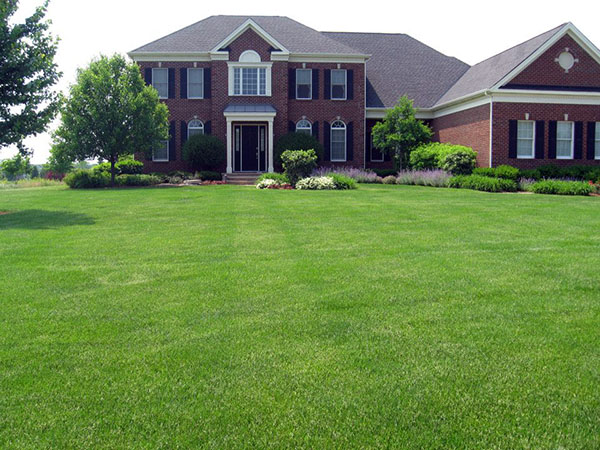
McEnery Lawn Care only uses custom blended slow-release granular fertilizers on Chicagoland Residential Lawns. All of our fertilizer mixtures are phosphate free to prevent groundwater contamination, and we also use sulfate of potash because of its reduced salt level for your lawn. Our balanced fertilizer formulations will feed your Chicagoland residential lawn consistently and evenly over an extended period of time. This will result in your lawn obtaining a darker green color, improved density, more uniform growth pattern and superior root system.
McEnery Lawn Care knows what it takes to make your Chicagoland lawn green, thick and weed free. Our promise to you is to provide your lawn with exactly what it needs when it needs it to keep your landscape beautiful for years to come.
RESIDENTIAL LAWN CARE SCHEDULE
- EARLY SPRING APPLICATION (MARCH – APRIL) – Slow release granular fertilizer & pre emergent crabgrass control
- LATE SPRING APPLICATION (MAY – JUNE) – Slow release granular fertilizer & liquid broadleaf weed control
- SUMMER APPLICATION (JUNE – JULY) – Slow release granular fertilizer w/ micronutrients
- LATE SUMMER APPLICATION (AUGUST) – Slow release granular fertilizer w/ micronutrients
- EARLY FALL APPLICATION (SEPTEMBER – OCTOBER) – Slow release granular fertilizer & liquid broadleaf weed control
- LATE FALL APPLICATION (NOVEMBER) – Slow release granular fertilizer w/ micronutrients
CHICAGOLAND RESIDENTIAL LAWN FERTILIZATION PROGRAMS
Traditional Fertilizers
These are man-made all mineral products where nitrogen release rate is primarily dependent upon moisture levels in the soil. They can be both quick and slow release in nature depending upon how they are coated.
100% Organic Fertilizers
These are typically byproducts from the plant and animal processing industry as well as waste products such as manure and sludges. Examples include composted poultry manure, feather meal and processed sewer sludge which is most commonly known as Milorganite. Organic compounds depend on microbial decomposition for their rate of nitrogen release.
Organic Based Fertilizers
We use these products, which are a combination of traditional and organic fertilizers the majority of the time because they provide the best of both worlds. They offer the cool weather performance of the traditional blends along with the slow release qualities and soil building benefits of the organic products.
ADDITIONAL RESIDENTIAL LAWN CARE SERVICES
Core Aeration
This process is designed to reduce soil compaction and make it easier for air, water and nutrients to reach the root zone. Core aeration assists in the development of a deep root system which leads to dense turf which is better able to cope with disease, drought and insect pressures. The removal of these 3 to 4 inch long cores of soil can be performed in either spring or fall and is arguably the #1 one way to keep your lawn in top shape.
Canada Geese Control
This application would be beneficial to those of you who live adjacent to ponds or any other bodies of water. The key is to get the geese to stop feeding and messing up your property with their droppings. We can spray your lawn with an odorless and harmless product which will last for several months when the grass is dormant.
Total Vegetation Control
We can spray a nonselective systemic herbicide to any areas where grasses and weeds are not desired. These products typically take between ten and fourteen days to work with replanting or mulching being able to occur afterward.
Insect Control
We have the ability to treat both surface and soil feeding insects should they become a problem in your lawn. There are two types of treatment options available for both categories of insects.
Preventative products will provide season long control of sub surface feeding insects but they must be applied before damage becomes evident. This is our recommended method for grub control provided that the application is made sometime between mid-June and mid-July of each year.
Curative products will quickly eliminate both types of existing insect problems. The downside with them in regard to grub control is that they are typically applied after animals such as starlings, skunks and raccoons have already done physical damage to the lawn by tearing it up in attempting to feed on the grubs. Often times reseeding or resodding of the damaged areas will be required after the curative treatment is applied.
Disease Control
Our lawn care programs are designed to keep your lawn healthy and strong. When proper fertilization is combined with cultural practices like core aeration, mowing with a sharp blade at the correct height and watering at the appropriate time of day, one can minimize the majority of turf diseases at a minimum. Fungicide applications can be beneficial when the environmental conditions are such that disease development seems imminent. It’s best to apply fungicide products when diseases have become evident and before they spread throughout the lawn.
Crabgrass Control
Crabrgass is an annual weed which sprouts from seeds in early spring, grows all summer and is killed off by the first hard frost in the fall. The best way to prevent crabgrass from invading your lawn is to maintain a healthy and dense stand of turf through proper fertilization. That being said, we typically apply crabgrass preventer along with the first application of granular fertilizer in the spring of each year. This is to keep crabgrass from germinating in areas along curbs and sidewalks where the ground tends to be more compacted and the turf stressed from de- icing materials used during the winter months.
Broadleaf Weed Control
We use liquid sprays to control a variety of broadleaf weeds including chickweed, clover, ground ivy, dandelion, henbit and spurge just to name a few. These systemic herbicide products are first absorbed through the leaf surface before traveling to the root system for complete elimination. These applications are typically applied in blanket form during May and September. They could also be applied on an as needed basis during the other portions of the year.
CHICAGOLAND SERVICE AREA
McEnery Lawn Care is based in Palatine, but we travel throughout the entire Chicagoland area. McEnery Lawn Care is committed to providing you with professional lawn care and landscaping services using only the finest materials and modern equipment, resulting in a lush lawn at a competitive price.
At McEnery Lawn Care, we have customers in Chicago, Palatine, Schaumburg, Arlington Heights, Northbrook, Barrington, Mount Prospect, Des Plaines, Elmhurst, Hinsdale and everywhere in between. We emphasize the “care” portion of lawn care is important to us so. We hope you will contact us today for lawn care or landscaping services by calling 847-358-TURF (847-358-8873).
We Have a Passion for Lawn Care and Landscaping
Discover the McEnery Lawn Care Advatange